Chapter Zero Slovenia
Adult Vaccination Remains an Underused Preventive Measure for a Healthy and Resilient Society
Ljubljana, 10 June 2026 – Adult vaccination is one of the key, yet still underused, preventive measures in Slovenia that can significantly contribute to healthy ageing, fewer hospitalisations, a less burdened healthcare system, and a better quality of life for older people. This was the central message of the health symposium organised by the British-Slovenian Chamber of Commerce at the Medical Chamber of Slovenia.
Improving adult vaccination coverage will require better access to vaccination, clearer communication, greater trust in professional expertise, and a stronger role of healthcare professionals, pharmacists, and employers. Adult vaccination should become part of healthcare throughout the entire life course, not only a response to a particular season or disease. At the same time, vaccination should be understood as an investment in a long-lived society, as it does not only prevent diseases, but can also mean fewer absences from work, higher productivity, and more healthy, independent years of life.
Healthy ageing is not only about living longer, but above all about living more years actively and with fewer health complications, Prof. Dr Bojana Beović, MD, PhD, President of the Medical Chamber of Slovenia, emphasised in her opening remarks. In older adults, the immune system weakens with age, while chronic diseases become more common. As a result, infections that younger people often overcome more easily can lead to pneumonia, worsening of underlying conditions, hospitalisation, or loss of independence. She added: “Adult vaccination is one of the most important, yet still underused, preventive measures. It is not only about protecting the individual, but also about relieving the burden on families, the healthcare system, and wider society. If we want to enable an ageing society to enjoy more healthy, high-quality years, we must understand vaccination as part of our efforts towards longevity.”
Health has long ceased to be only a healthcare issue. It is also an economic, social, and developmental issue, explained Luka Vesnaver, Chairman of the British-Slovenian Chamber of Commerce. Across Europe, companies are facing labour shortages, an ageing workforce, and the challenge of how to preserve employees’ knowledge, experience, and productivity. Employee health is therefore becoming a strategic question of long-term resilience and competitiveness. “Vaccination is often discussed as a cost. In reality, it is one of the few areas where relatively small investments can deliver major effects. Less disease, fewer complications, fewer absences from work and, above all, a better quality of life,” said Vesnaver.
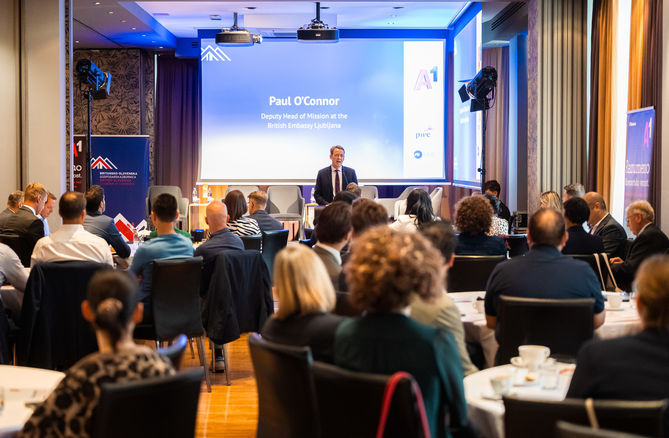
At a time of confusion around health policies, vaccination, and online self-diagnosis, cooperation between experts in addressing myths and sharing evidence is more important than ever, emphasised Nigel Baker, Chargé d’Affaires at the British Embassy in Ljubljana, in his opening remarks: “I am delighted that this event, supported by the excellent British company GSK, highlights the strength of UK-Slovenia collaboration on healthy ageing, an issue affecting societies across Europe. It is encouraging to see NHS and Slovenian experts working together to address myths and share evidence.”
The first expert presentation was delivered by Dr Catherine Heffernan from NHS South West London, who presented the organisation of adult vaccination programmes in the United Kingdom. She emphasised that the system is based on national programmes, clear recommendations, multiple entry points for vaccination, and cooperation between public health institutions, healthcare providers, general practitioners, pharmacies, and local communities. The UK was the first European country to introduce a national shingles vaccination programme, with results showing a significant reduction in healthcare consultations and complications.
Despite its well-developed system, the UK has also faced declining trust and lower vaccination coverage in some age groups following the COVID-19 pandemic. Dr Heffernan noted that vaccine hesitancy does not necessarily mean refusal, but often results from a combination of unclear information, mistrust, poorer access, social inequalities, and exposure to misinformation. To improve vaccine acceptance, clear communication, warnings about false information, trust-building, and support for healthcare professionals are therefore essential, so that they can provide patients with reliable and understandable information.
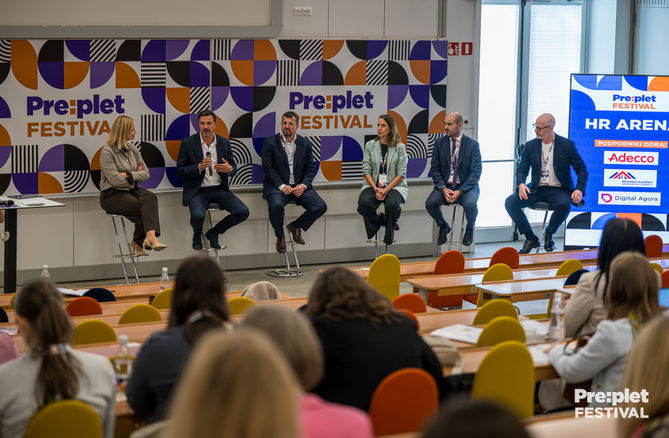
The UK’s experience with adult vaccination programmes then opened the first panel discussion on where the main opportunities for improvement lie in Slovenia.
Access and trust are important factors in people’s decision to get vaccinated, confirmed Nina Grasselli Kmet, MD, PhD, Head of Vaccination Center at the Ljubljana University Medical Centre. In her experience, people are more likely to get vaccinated when vaccination is easily accessible, close to them, and available at a convenient time. An example of good practice is mobile flu vaccination teams, which have made it possible for employees to get vaccinated at their workplace.
According to her, the most common questions people have relate to vaccine safety, side effects, and whether vaccination is really necessary. This is why personal conversations with healthcare professionals remain essential, as they can explain the benefits and risks of vaccination in a professional, clear, and understandable way.
To achieve higher adult vaccination coverage, vaccination should be more firmly integrated into regular healthcare, added Dr Marta Grgič Vitek, National Vaccination Coordinator at the National Institute of Public Health. Slovenia’s national vaccination programme has a tradition of more than 60 years, and high vaccination coverage among children has meant that many diseases today occur only rarely, or not at all. Among adults, the situation is different, as vaccination is not organised in the same systematic way. Family medicine practices and preventive care clinics could play an important role by checking patients’ vaccination status during preventive check-ups and referring older people for recommended vaccinations.
Zdravstveni dom Medvode also has a long tradition of vaccination, emphasised its director, Prim Dr Rajko Vajd, MD, PhD. Medvode was among the first municipalities to provide access to HPV and tick-borne encephalitis vaccination free of charge even before it was included in the national programme. Vaccination against tick-borne encephalitis is particularly desired locally, mainly due to the proximity of the Kamnik-Savinja Alps and the higher exposure of the population. In his view, family doctors are one of the key entry points for adult vaccination, especially for chronic patients and people over the age of 65, with whom they maintain regular contact through preventive care clinics.
Pharmacies could also help improve both access to vaccination and trust in prevention. Darja Potočnik Benčič, MSc, President of the Slovene Chamber of Pharmacy, noted that chronic patients visit pharmacies frequently, not only to collect medicines, but also for advice and personal contact. Pharmacists enjoy a high level of trust among patients, while the pharmacy network covers the whole of Slovenia. Practices from other countries show that pharmacies can contribute to higher vaccination coverage by making information, counselling, and vaccination more accessible. In her view, pharmacies in Slovenia therefore remain an underused channel for promoting vaccination and could also serve as vaccination sites.
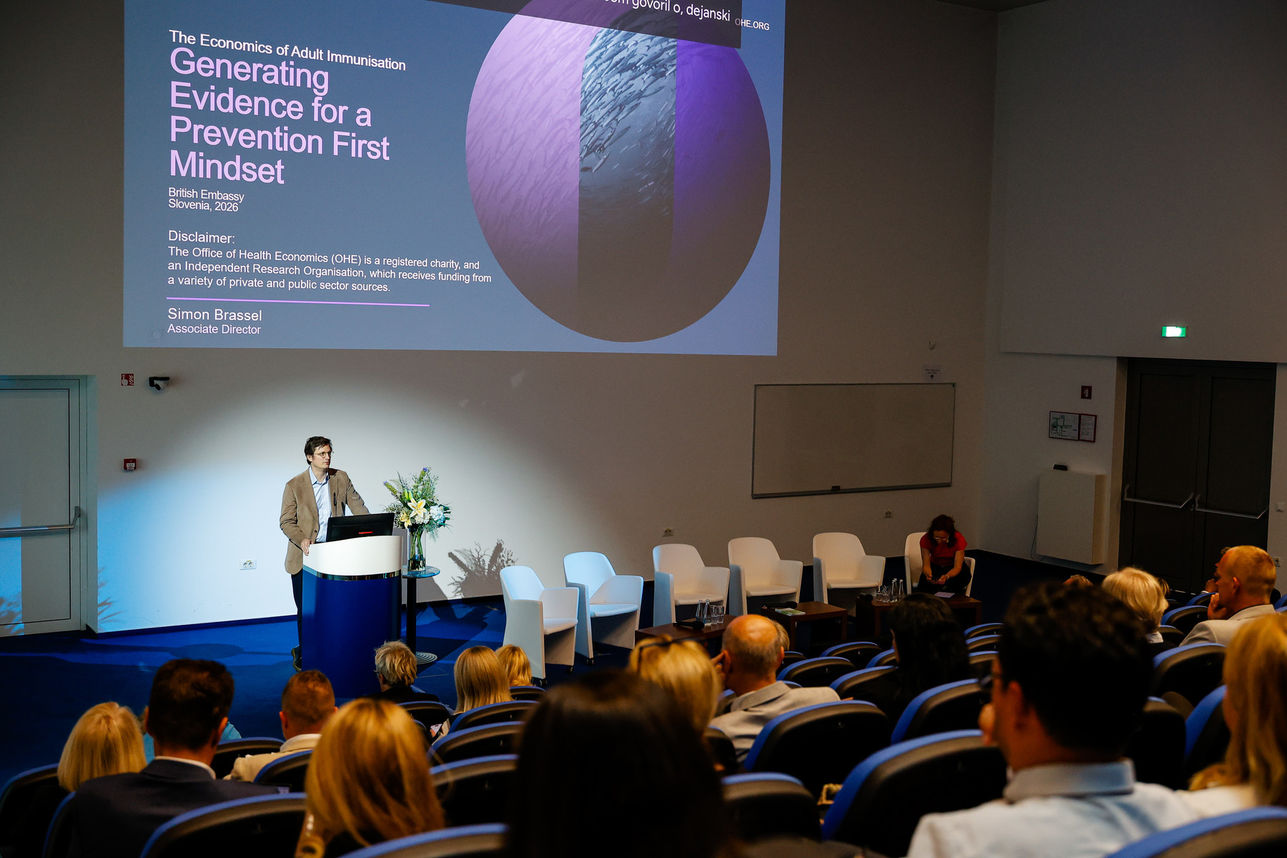
The socio-economic value of adult vaccination programmes was outlined in the second part of the symposium by Simon Brassel from the Office of Health Economics (OHE). He emphasised that the value of vaccination is often assessed too narrowly, mainly through direct healthcare system costs, while many of its effects are felt more broadly, in the economy, the labour market, social care, and the quality of life of individuals and their families.
The OHE analysis shows that adult vaccination programmes create value on several levels: they reduce the burden of disease, prevent hospitalisations and deaths, relieve pressure on healthcare systems, reduce absences from work, preserve productivity, and support healthier ageing. When these broader societal effects are taken into account, adult vaccination programmes can generate returns of up to 19 times the original investment. A case study presented from the UK showed that every £1 invested in respiratory disease vaccination can generate between £5 and £19 in societal value within the first year alone.
Brassel also pointed out that public budgets often fail to reflect the real value of prevention. In Slovenia, 9.9 percent of GDP was allocated to healthcare in 2025, while prevention accounted for 3.3 percent of healthcare expenditure, or 0.3 percent of GDP. Improving vaccination programmes will therefore require a shift towards understanding health as a long-term investment in society, with more stable funding for prevention, broader assessment of vaccination benefits, and a stronger role for employers in employee health.
The question of how to understand the value of vaccination beyond healthcare costs alone was at the centre of the second panel, which focused on adult vaccination as an investment, not a cost.
Building on Brassel’s point that much of the value of vaccination is generated outside direct healthcare expenditure, Petra Došenovič Bonča, PhD, Associate Professor at the Faculty of Economics, stressed that the costs of vaccine-preventable diseases should be communicated more clearly. In Slovenia, around 27 euros per person per year are allocated to vaccination, which is significantly lower than the costs that severe infectious diseases can generate for the healthcare system and society.
These costs go far beyond treatment. They include hospitalisations, premature mortality, long-term sick leave, early retirement, and exit from the labour market. She also noted that people are often unaware of the wider costs of disease complications. In the case of herpes zoster, for example, research increasingly points to links with long-term consequences, including dementia.
Prof Alenka Kraigher, MD, MSc, PhD, former Head of Communicable Diseases Center at the National Institute of Public Health, reminded us that vaccination is one of the most important achievements of modern society because it prevents diseases before they occur. While Slovenia has a well-organised vaccination system, she noted that adult vaccination coverage remains too low. One of the key challenges, in her view, is trust, as many people today are more concerned about vaccination than about the diseases it helps prevent.
Trust and understanding of risk are also central to how people perceive vaccination. Mitja Vrdelja, PhD, Head of Communication Centre at the National Institute of Public Health Slovenia, emphasised that vaccination in Slovenia is a success story, especially among children, where coverage in many programmes reaches high levels. Among older people, however, it remains much lower. This year’s flu vaccination season did bring a positive shift, with around 40,000 more people vaccinated than the year before and the highest coverage in the past 15 years. Nevertheless, coverage among people over 65 remains far below the World Health Organization’s 75 percent target.
He also stressed that communication should focus not only on the safety and effectiveness of vaccines, but also on the burden of the diseases they prevent. People are more likely to choose vaccination when they understand the serious risks that the disease poses.
The example of Vzajemna Health Insurance showed that prevention is also relevant for employers. The company offers its employees vaccination against tick-borne encephalitis, with employees informed about vaccination options at the beginning of the year and the cost covered by the company. Rok Jemec, Advisor to the Management Board, also pointed out that employee vaccination is still treated as a taxable benefit, which shows that the system often views prevention as a cost rather than an investment in employee health.
The symposium and both panel discussions were expertly moderated by Lucija Bošnik Petavs, former Editor-in-Chief of the specialised medical publication Medicina danes.
The symposium was supported by the Main Partner GSK and Partner Pfizer.
The photo gallery is available here.
Photo: Saša Despot (Mediaspeed)