Chapter Zero Slovenia
Slovenian Companies Set to Benefit from Simpler, Faster Trade with the UK
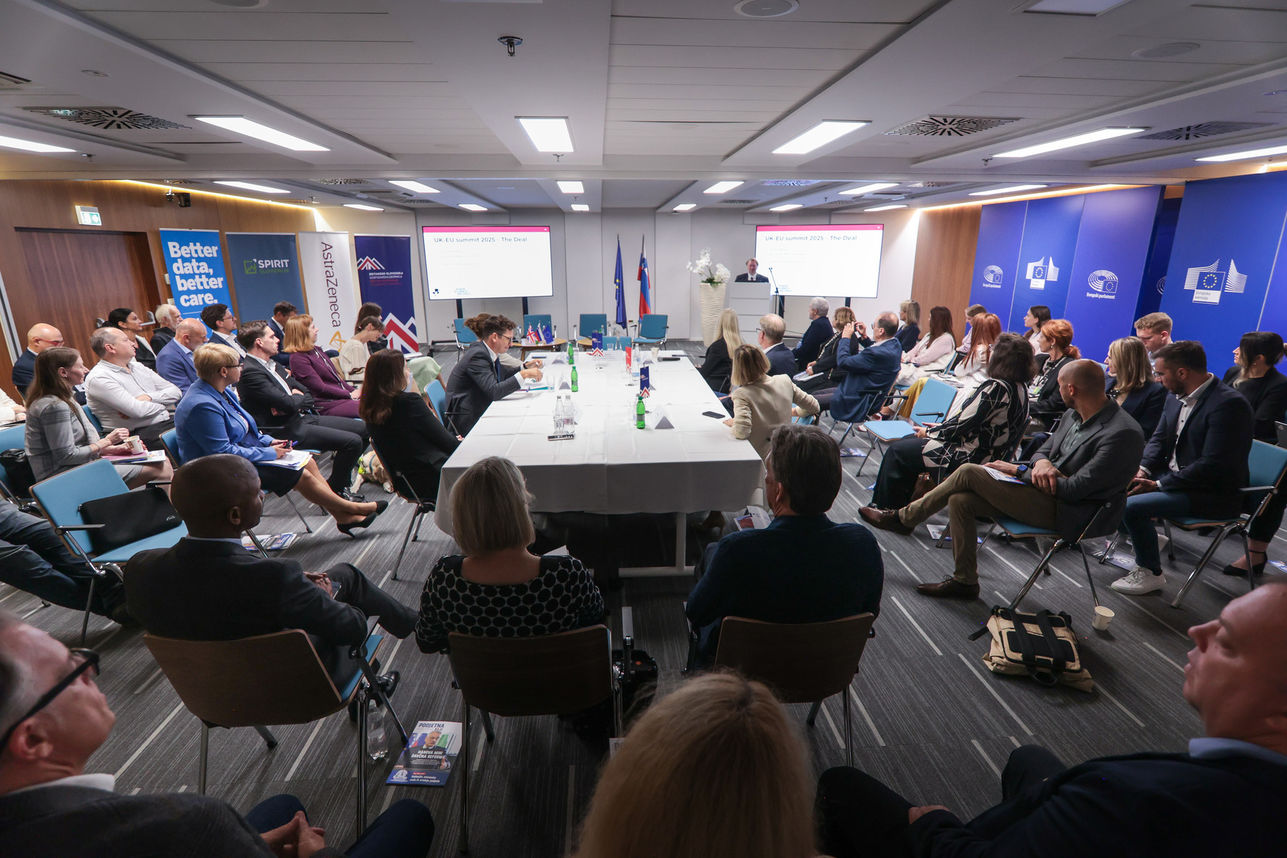
Ljubljana, 12 September 2025 – The future of trade relations between the United Kingdom and the European Union was at the centre of the UK-EU Trade Conference, organised by the British-Slovenian Chamber of Commerce at the House of the EU. The discussion outlined that the EU remains the UK’s closest and most important trading partner, and that a new agreement – expected in the coming year – will reduce red tape on agri-food and plant products, strengthen cooperation on defence and security, expand opportunities for students through the UK’s return to Erasmus+, and provide new momentum for trade and investment.
The United Kingdom, the world’s sixth-largest economy, represents an attractive market for Slovenian companies. Total trade between the UK and Slovenia exceeded one billion euros in 2024 for the first time, with Slovenian exports reaching 860 million euros – more than double compared to 2019. At the same time, British companies have invested 538 million euros in Slovenia, making the UK one of Slovenia’s ten largest foreign investors.
The conference was opened by Barbara Uranjek, CEO of the British-Slovenian Chamber of Commerce, who stressed that the fact that Slovenian exports to the UK have doubled demonstrates the strength and potential of our bilateral relations: “We are extremely happy to organise this conference at such a crucial moment. The expected EU-UK agreement is not only about reducing barriers but also about creating a framework for deeper partnership. Slovenian and British companies alike stand to benefit.”
Looking ahead to the negotiations between the EU and UK due to begin this autumn, William Bain, Head of Trade Policy at the British Chambers of Commerce, underlined in his keynote address that they “will offer huge potential benefits in terms of quicker, simpler and cheaper trade in goods between Slovenia and the UK. The removal of export health certificates, associated border checks, costs and delays will help our trade in goods grow again, particularly in agri-food and plant products.”
The keynote was followed by the Leaders’ Top Talk, which brought together senior representatives of EU institutions, the Slovenian government, and the UK. Welcoming the opportunity to discuss trade between the UK and Slovenia at the conference, H.E. Victoria Harrison, British Ambassador to Slovenia, underlined a number of strategic opportunities that lie ahead: “The UK is a strong, reliable partner for business and a leader in innovation. The UK-EU Strategic Partnership – featuring reduced red tape, streamlined customs checks, and an SPS agreement – makes trade smoother. Slovenian companies have compelling reasons to invest in the UK. Our Trade and Defence Industrial Strategies drive sustainable growth, forge long-term partnerships, and position defence as an engine for prosperity. Europe remains the UK’s largest trading market, and we’re creating opportunities, easing burdens, and raising awareness of support to help businesses thrive.”
Highlighting our shared values and areas of interest, Jerneja Jug Jerše, Head of the Representation of the European Commission in Slovenia, stressed that while there is now a clear roadmap for cooperation, the complexity of bureaucracy remains a challenge: “The common understanding between the EU and the UK provides a strong foundation to deepen cooperation in areas such as trade, education and security. While the direction is clear, the details will depend on the evolving international context.” She added that it will be equally important to simplify procedures and reduce bureaucracy to ensure these opportunities translate into practice.
While certain burdens in trade remain, Slovenia has established an ad hoc group to address these challenges. Karla Pinter, Director General of the Internal Market Directorate at the Ministry of Economy, Tourism and Sport, explained: “Together with businesses, we are identifying the barriers that most affect companies, and we are presenting these findings at the EU level, where they can inform legislative discussions.” This bottom-up approach ensures that the real challenges of companies are heard and addressed.
The conference then continued with a panel discussion moderated by Žiga Fišer, Senior Trade Consultant at the British-Slovenian Chamber of Commerce, highlighting both success stories of Slovenian companies present in the UK market, and the reforms needed to further improve Slovenia’s attractiveness for foreign investment.
Among the Slovenian companies successfully building their presence in the UK market is Trimo. Nay Tawile, CEO of Trimo, reflected on their journey: “Trimo UK Ltd. was established more than 20 years ago and today generates 20 percent of the Group’s international revenue, with the UK being our most important foreign market. Our strong ad hoc organisation allows us to tackle different export challenges effectively, although we would appreciate regulatory & compliance alignments, as well as speedier supply chain processes.”
A similar perspective was offered by Tomaž Gornik, Owner and CEO of Better, which has built a significant presence in the UK health sector: “The UK accounts for 50% of our business. Having a local entity allows us to compete in public tenders, while also enabling us to export to Commonwealth countries under more favorable conditions than through the EU.” He noted that in practice, the UK market operates much like any EU country. Since each public health system has its own specificities, it makes little difference.
On the contrary, Vita Godec, Managing Director of Lenis Farmacevtika, reflected on the regulatory challenges facing the pharmaceutical sector: “Patients often have to wait for medicines due to lengthy customs and administrative processes. The regulatory environment needs to be harmonized and simplified. Before Brexit, the European Medicines Agency was based in London, but now it is in Amsterdam. The UK has its own rules, which adds to complexity.”
The conversation also turned to Slovenia’s business environment. Ksenija Purković, Country Director of AstraZeneca Slovenia, underlined Slovenia’s growing role in healthcare and life sciences: “With strong universities, a growing startup ecosystem, and a trusted healthcare system, the country has all the right ingredients to be a credible partner in biopharma innovation. At AstraZeneca, we support this progress through long-term investment in people, sustainable practices, and youth education, such as our Young Health Program, which has reached over 300,000 students. Our Slovenian team plays a vital role in the wider Balkan cluster, pioneering green solutions like a fully electrified fleet and environmental initiatives later adopted across the region. We continue to believe that Slovenia’s innovation potential will only grow, especially with supportive policies that enable faster access to new medicines.”
Shifting focus to the regulatory and fiscal environment, Azra Begič Milanez, Founding Partner of A Tax International, stressed: “We are not competitive in terms of tax and social security, which is creating a burden for employers, but we are strong in R&D allowances. I believe Slovenia is competitive overall, and while we need tax revenues for our budget, we must reduce the administrative burden. For example, many countries have already abolished fiscal representatives, and I believe this should happen in Slovenia as well, as the requirement adds extra hurdles for UK businesses entering our market.”
On the other hand, Aleš Šifrer, People & Transformation Director at Arriva Slovenia, stressed the importance of smoother labour market procedures to support foreign investment: “Bringing in foreign employees has several layers – navigating regulations, integrating them into the company, and helping them settle into the community. Sometimes there is pushback from the local environment not fully accepting these workers and we have to work on this. One of the issues is also how the legislation is applied: for example, if a single case handler is on leave, no one else may be handling your application. We have to make the process more business-friendly.”
Reflecting on these challenges, Nay Tawile (Trimo) added that Slovenia offers excellent talent, high-quality goods, and a good quality of life, but SMEs often face high risk aversion, which can limit their growth. She highlighted that by digitalising processes and simplifying administrative procedures, Slovenia could attract more investment and gain a competitive advantage without changing legislation. “We should not let our size or perceptions limit us – to go global, we need to take more risks and think more how we can scale internationally,” she concluded.
We would like to thank the following partners who made the conference possible: Main Partner – AstraZeneca Slovenia, Partners – SPIRIT Slovenia and the Ministry of Economy, Tourism and Sport, and Supporter – Better.
Photo highlights are available here.