Chapter Zero Slovenia
Tea with Reason in Maribor on Štajerska’s Economic Potential and the Drivers of Future Growth

Maribor, 16 April 2026 – How to turn Štajerska’s existing competitive strengths into higher value creation, build an environment that retains and attracts talent, and make more effective use of these assets to draw in investment was at the centre of the Tea with Reason event in Maribor, organised by the British-Slovenian Chamber of Commerce in partnership with SPIRIT Slovenia, the Ministry of the Economy, Tourism and Sport, and the Municipality of Maribor. The discussion showed that the region does not lack potential, but rather more coordinated action, a clearer sense of direction, and sustained long-term investment. Future progress will depend on how effectively business, knowledge, and infrastructure can be aligned into a coherent development framework, a point further illustrated by the guest from the United Kingdom, who presented Manchester as an example of a successful transition from an industrial city into a modern, competitive economy.
The opening remarks reflected a clear shift in how the region’s development is taking shape, increasingly driven by ambition, expertise, and concrete projects. Maribor, which is steadily positioning itself as a development hub with a strong geostrategic location and a high concentration of knowledge, is, according to Mayor Aleksander Saša Arsenovič, moving beyond its traditional image: "Maribor today is no longer an industrial city, but is increasingly recognised as a hub of opportunity and innovation," adding that "our response to brain drain is not just words, but concrete opportunities and modern infrastructure that set the pace of development in Štajerska."
A broader regional perspective was offered by Tamara Zajec Balažič, Director of SPIRIT Slovenia, who pointed to the need for more coordinated action in shaping Štajerska’s future: "Štajerska is a region with significant development potential, as it represents one of the strongest industrial bases in Slovenia, with more than 30,000 companies generating over €16 billion in revenue. However, potential alone is not enough." She noted that the region continues to face challenges related to competitiveness, the availability of high-quality jobs, and the retention of talent and knowledge, concluding that "the ability to align different interests into a shared development framework will be decisive for its long-term competitiveness."
An international perspective was provided by Nigel Baker, Chargé d’Affaires at the British Embassy in Ljubljana, who pointed to important parallels with Manchester: "Maribor and Manchester have different histories but share a similar industrial past." He noted that "long term economic strength depends on diversification, strong skills, and the ability to adapt," adding that Manchester’s transition offers useful lessons for regions facing similar challenges today.
Key economic indicators were then outlined by Bojan Ivanc, Chief Economist at the Chamber of Commerce and Industry of Slovenia. While the region represents an important part of the Slovenian economy, it is also characterised by structural challenges such as an ageing population, talent outflow, and relatively lower investment in research and development. At the same time, it benefits from a strong base of small and medium-sized enterprises and good connections with neighbouring markets, providing a sound foundation for future growth.
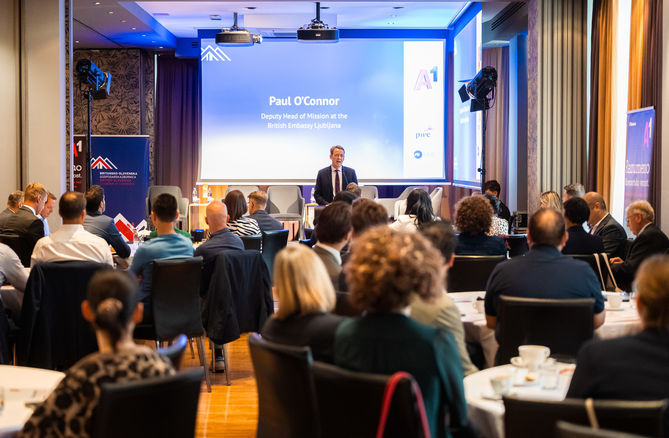
The special guest from the United Kingdom, Subrahmaniam Krishnan-Harihara from the Greater Manchester Chamber of Commerce, shared Manchester’s transition from an industrial city to a modern, competitive economy. He emphasised that this shift was not the result of a single action, but of consistent, long-term and well-coordinated efforts. Among the key drivers of success were sustained investment in urban regeneration, the development of business districts, infrastructure and public transport, as well as stronger local decision-making. This combination of clear priorities and continued investment has enabled Manchester to become one of the fastest-growing economies in the country today.
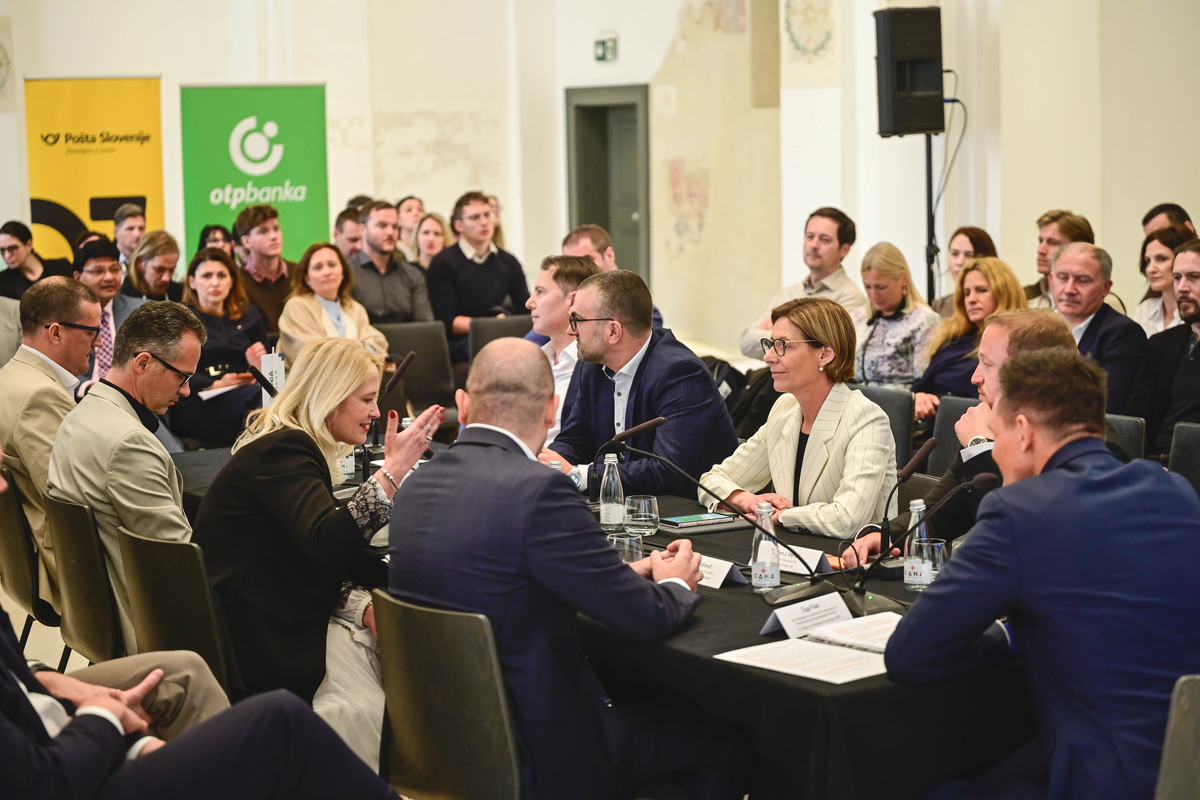
The panel discussion that followed focused on how Štajerska’s existing strengths can be turned into concrete development opportunities, with particular emphasis on investment, talent development, and stronger collaboration among different stakeholders. Drawing on practical experience, business representatives shared that the key challenges are already well understood, but that real progress will depend on a more coordinated approach in addressing them.
In this context, Sabina Župec Kranjc, Member of the Management Board of OTP Bank, underlined the importance of closer cooperation between business, banks, universities, and the local environment for future development and talent retention: "Štajerska can be a strong development story – if we invest in projects and people at the same time. At OTP Bank, we have a long-standing presence in this region and remain a partner to the business community and an important employer, particularly in areas such as digitalisation, data, and modern banking expertise."
Ivana Vrviščar, Member of the Management Board of Pošta Slovenije, also pointed out to the region’s strong potential, particularly in logistics, from a dense road network and strategic rail corridors to the presence of an airport. At the same time, she noted that these elements are not yet sufficiently integrated into an efficient and competitive logistics system: "As a company headquartered in the Štajerska region and managing key logistics flows, we clearly recognise an opportunity to develop a regional distribution hub of wider significance." She added that the region faces challenges such as lower value-added output, outflow of young talent, labour shortages, and underutilised logistics and transport capacities, which, with the right development approach, can be turned into a competitive advantage.
Paloma offers a strong example of how companies in the region can move towards higher value creation through targeted investment in technology and automation. As President of the Management Board Jernej Tovšak emphasised, adaptability is central to this: "As a manufacturing company with a long-standing tradition in the region, Paloma operates in the midst of complex market dynamics. Energy vulnerability is not just a theoretical issue for us, but a key operational challenge, as the paper industry is among the most energy-intensive sectors." He added that the company’s response is grounded in a proactive approach: "At Paloma, we do not rely on passively waiting for more favourable market conditions, but are implementing key strategies in energy efficiency, diversification, and sustainability."
The discussion showed that Štajerska has solid foundations for further development, but that its future success will depend primarily on the ability to collaborate, think long-term, and act decisively in delivering key development and infrastructure projects.
The panel also featured Žan Dapčevič, Co-founder and CEO of Academia; Tadej Gosak, CEO of Marles hiše; Tilen J. Heržič, CEO of Špedicija TIM; Uroš Mlakar, Founder of Naturalica Foods; and Tomaž Orešič, Vice President at Resalta. The discussion was moderated by Žiga Fišer from the British-Slovenian Chamber of Commerce.
A special thank you goes to the event partners: Chamber of Commerce and Industry of Štajerska, OTP Bank, Pošta Slovenije, and Paloma.
The photo gallery is available here.
Photo: MP Produkcija